Growing Native: How Prairie Projects Benefit STLCC’s Campuses and Communities
October 22, 2026
Posted by STLCC in Campus Life
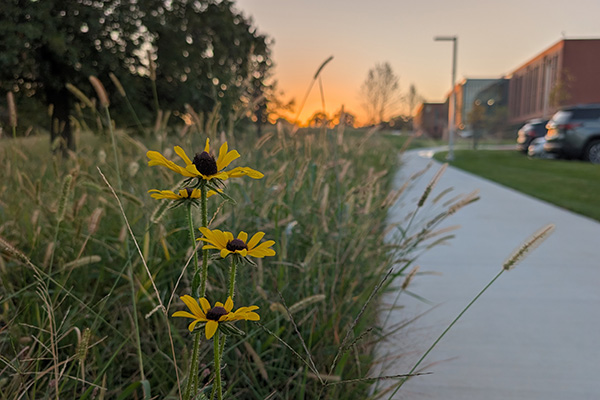
What might currently look like weeds and overgrown fields is actually part of St. Louis Community College’s approach to creating more sustainable campuses.
At STLCC-Wildwood and STLCC-Meramec, native prairie installations are helping manage stormwater, support local wildlife and reduce long-term landscaping costs. At the Meramec campus, a dedicated prairie classroom also provides hands-on learning opportunities for horticulture students.
With another prairie installation planned for STLCC-Florissant Valley this November, the College is showing how environmental stewardship and education can grow together.
Environmental Stewardship
For Christa Taylor, STLCC district grounds manager and registered landscape architect, these native plantings represent a visible, tangible commitment to environmental stewardship.
“When you’re in our prairies, you can see and feel our commitment to sustainability,” Taylor says. “Sustainability is really about looking at the long-term impact of the decisions we make. From a landscape perspective, that means thinking about water, soil, plant selection, habitat, maintenance and the resources required to manage our campuses.”

Native prairie plantings at STLCC-Wildwood help manage stormwater, support wildlife and reduce long-term landscaping costs.
Traditional turfgrass has shallow root systems that absorb little water after heavy rainfall, often worsening soil erosion and runoff that can overwhelm stormwater management infrastructure. However, prairie root systems can reach 10 to 15 feet deep, helping absorb stormwater, prevent erosion and support healthier soil.
“These areas are great for stormwater management,” says Taylor. “We have specific soils tailored for our bio-retention and water basins, paired with plant material adapted specifically for wet or dry conditions.
“This plant material is indigenous to our Missouri area,” she adds. “It has adapted to our rainfall, our climate and our soils. You have the opportunity to see Black-Eyed Susans, coneflowers and bluestem. We have bees, butterflies and migrating birds coming in to feed. A native-seeded area creates a level of soil health, water management and biodiversity that you just can’t achieve with standard turf.”
Smart Economics: Sustainability That Saves
While native prairies can take three to five years to fully establish, they require significantly less maintenance than traditional lawn landscapes once established, leading to long-term cost savings. Instead of weekly mowing, regular watering and chemical treatments, established native-seeded areas typically need mowing once or twice a year.

A newly seeded prairie area begins to take shape, with straw and erosion-control netting protecting the soil as native plants become established.
“This helps our long-term sustainability by decreasing the cost of mowing, the energy and fuel to mow, chemical applications, and the amount of water we use on campus,” explains Taylor. “There are no pesticides or irrigation systems needed in these areas once established.”
At STLCC-Meramec, the prairie installation along Big Bend Road also addresses a practical challenge: the pre-existing lack of irrigation. Because native plants are drought-tolerant and adapted to the local climate, they can thrive without regular watering, eliminating the need for irrigation infrastructure and water supply.
A Living Classroom
STLCC’s prairie installations are also creating hands-on learning opportunities for students.
At the Meramec campus, two native-seeded installations serve distinct purposes: the contractor-maintained prairie enhances campus sustainability, while a dedicated teaching prairie turns ecological restoration and land management into practical experience for horticulture students.
Installed in spring 2026, the horticulture program’s 1.5-acre teaching prairie was made possible by a donation of seeds and services from Missouri Native Stewardship Services, LLC. For Jerry Pence, horticulture program coordinator, the prairie bridges the gap between concept and practice.

Campus prairie spaces give STLCC students opportunities to study native plants and local ecosystems.
“With this native-seeded landscape, students have the unique opportunity to apply the skills learned in the classroom right here on campus,” explains Pence. “This prepares them for employment in this growing sector of our industry, where they will then master their skills.”
With guidance from faculty and industry professionals, students gain experience in every phase of the ecosystem’s development: assisting with native seed distribution and installing straw erosion blankets to stabilize topsoil, learning to distinguish desirable native seedlings from opportunistic weeds during the fragile first year and tracking establishment milestones while removing species that threaten native biodiversity.
This hands-on work prepares students for in-demand careers in Missouri’s green industry, including conservation, landscape management and sustainable design.
The Three-Year Journey
Understanding prairie establishment requires patience and a shift in perspective. The conservation industry uses a common phrase to describe the process: “Sleep, Creep, Leap.”

Native prairie growth follows three stages: “Sleep, Creep, Leap.” In year one, plants
focus on root growth. In year two, they grow taller and some begin to bloom. By year
three, most are established, with more species flowering. Mowing and weed control
support growth along the way. Graphic provided by the Missouri Prairie Foundation’s Grow Native! program.
While a site takes three to five years to fully mature and requires painstaking effort along the way, the result is a self-sustaining, beautiful ecosystem that grows more robust over time, unlike traditional landscapes that deteriorate without constant intervention.
Looking Forward
The prairie installations are part of STLCC’s broader approach to sustainable campus design and its pursuit of Leadership in Energy and Environmental Design (LEED) standards.
With another native-seeded installation planned for STLCC-Florissant Valley this November, STLCC will have native prairie areas on three of its campuses, creating a network of sustainable campus landscapes that serve as models for other institutions and demonstrate what’s possible when environmental stewardship, educational innovation and fiscal responsibility align.
“When people see our native prairies, I’d like them to understand that it isn’t an area that we simply stopped mowing,” says Taylor. “It’s an intentionally designed and managed landscape that provides habitat, supports pollinators and allows us to manage part of our campus in a more sustainable way.”
Taylor also notes the tremendous benefits to students when the landscape functions as part of the learning environment.
“One of the things I really like about having these spaces on campus is that sustainability becomes something students can see and experience,” she says. “You don’t have to be studying horticulture or environmental science to benefit from it. You can walk past the prairie, watch it change throughout the seasons, see pollinators using it and experience a different kind of campus landscape.”