On the Use of AI in Classwork: A Note of Caution
September 04, 2026
Posted by Amy Perry, PhD in AI Articles and Guides
Large language models (LLMs) like ChatGPT and Gemini have had a significant impact on education. A Pew Research Center study in January 2025 indicated that at least one in four teenagers use ChatGPT for schoolwork, a number that has potentially grown since then as LLMs have become more ubiquitous in society.
Of course, “using ChatGPT for schoolwork” is a broad category that encompasses everything from seeking assistance in understanding a topic to asking ChatGPT to do your homework for you. ChatGPT’s website offers numerous suggestions for how students can use their service to help them learn, and includes suggestions such as:
- Creating practice quizzes
- Developing flash cards
- Creating study games
The same Pew Research survey indicated that a smaller number of students (18%) say it is acceptable to use ChatGPT to write essays. Even so, that suggests that as of January 2025 nearly one in five teens have used ChatGPT for writing essays or consider it acceptable to do so.
Here at STLCC, academic integrity is emphasized as a core institutional value. While there are acceptable uses for LLMs, the current policy at STLCC is that individual faculty must determine if — and to what extent — LLMs can be used in conjunction with classwork. Students who take LLM outputs and present them as their own work are committing an act of academic dishonesty, which can carry significant consequences.
In this blog I want to highlight two issues that go beyond academic integrity concerns, which are as follows:
- LLM usage may prevent students from contributing to the production of knowledge
- The persistence of LLMs in high education may hinder opportunities for connection and community in online classes
I will follow a brief discussion of these two concerns to discuss how LLMs may facilitate the writing process.
The production of knowledge in the classroom
Customarily in educational discourse, students are positioned as learners—as empty wells to be filled. But students are also teachers who are experts on their own life history. STLCC is fortunate to have a diverse student body that consists of different experiences, and expectations. No two students enter the classroom with the exact same background.
In this way, students are not just recipients of knowledge but producers of knowledge. They can take the ideas they’ve learned and hold those ideas up against their experiences. They can assess the strengths and weaknesses of those ideas and locate the boundaries of what disciplines like sociology can or can’t explain about their own lives. As a teacher of sociology, I begin each new semester knowing more about the world than I did the semester prior because of what I’ve learned from my students. I can share that knowledge, and the process continues.
Where is this knowledge produced? It is typically not produced in exams, which assess students for retention and understanding. It comes in the form of discussions, writing assignments and other open-ended exercises. It is produced when students respond to questions like “do you think socioeconomic status counts as an achieved status or an ascribed status?” in earnest, by drawing on their experiences.
LLMs cannot produce this knowledge. They can facilitate, perhaps, but they cannot produce. The output of an LLM depends on what that LLM has been trained on, which in turn comes from work previously produced by humans. Some studies suggest that when LLMs are trained on their own outputs, they may experience model collapse.
When a student uses an LLM to write a paper in response to a prompt about their perspective or their experiences, the LLM cannot say something new. It can produce a paper that may be broadly similar to that student’s experiences, but it cannot tell that student’s story. The novelty of an LLM’s output can only come from a student’s unique inputs.

Classroom conversations give students space to bring their own experiences into the discussion.
AI as a roadblock to community and connection in online courses
LLMs have the potential to impact all classes regardless of modality, but arguably the most significant impact is in online classes where all interaction is web-based. A strong online course is one that encourages regular interaction between students. This lessens the risk of students feeling isolated and disconnected. Student-to-student interaction is also a vehicle of learning, and in disciplines like sociology it’s where students are exposed to perspectives beyond their own (and the instructor’s).
The traditional form of student-to-student interaction in online courses is the discussion board. The typical format involves students replying to an initial prompt and then replying to other students. While this format may not be the most innovative, it at least requires students to read and engage with another student’s ideas. Since LLMs have become more common, these discussions have rapidly degraded. Students can paste another student’s post into an LLM and generate a reply that is often “good enough,” all without ever actually reading and thinking about that student’s work.
Of course, discussion board assignments are from a different era of the internet. Faced with this problem, the need to design new assignment formats in an era of AI is clear. The issue I am highlighting here is not that old assignment formats should never be replaced, but rather that LLM usage potentially stands as a barrier that prevents connections between students. In online learning environments, loneliness and isolation are major concerns that can impact student success.
Whatever form assignment redesigns take, the written word will remain the principal form of communication between students in an asynchronous online class. When students use LLMs to read and respond to each other, they are not interacting with each other. They are interacting with a chatbot. This largely nullifies opportunities for students to connect with one another over the content and the shared learning process.
AI as a facilitator to writing and other resources at STLCC
It is not the purpose of this article to paint a wholly negative picture of LLMs and their role in education. Rather, it is to highlight issues that need to be addressed. Overreliance on LLMs cost students an opportunity to share their experiences and connect with both their fellow students and their instructors. Opportunities for learning are constrained in an environment where the principal actors are using chatbots to do their writing for them.
Some instructors allow students to use LLMs, and potential productive uses for LLMs include:
- Brainstorming ideas
- Creating a paper outline
- Editing for spelling and grammar
Whether a class allows AI use or not, STLCC students can also seek assistance with their papers by using the Writing Center, which has options for online and in-person assistance. STLCC also hosts resources for writing, including articles and videos.

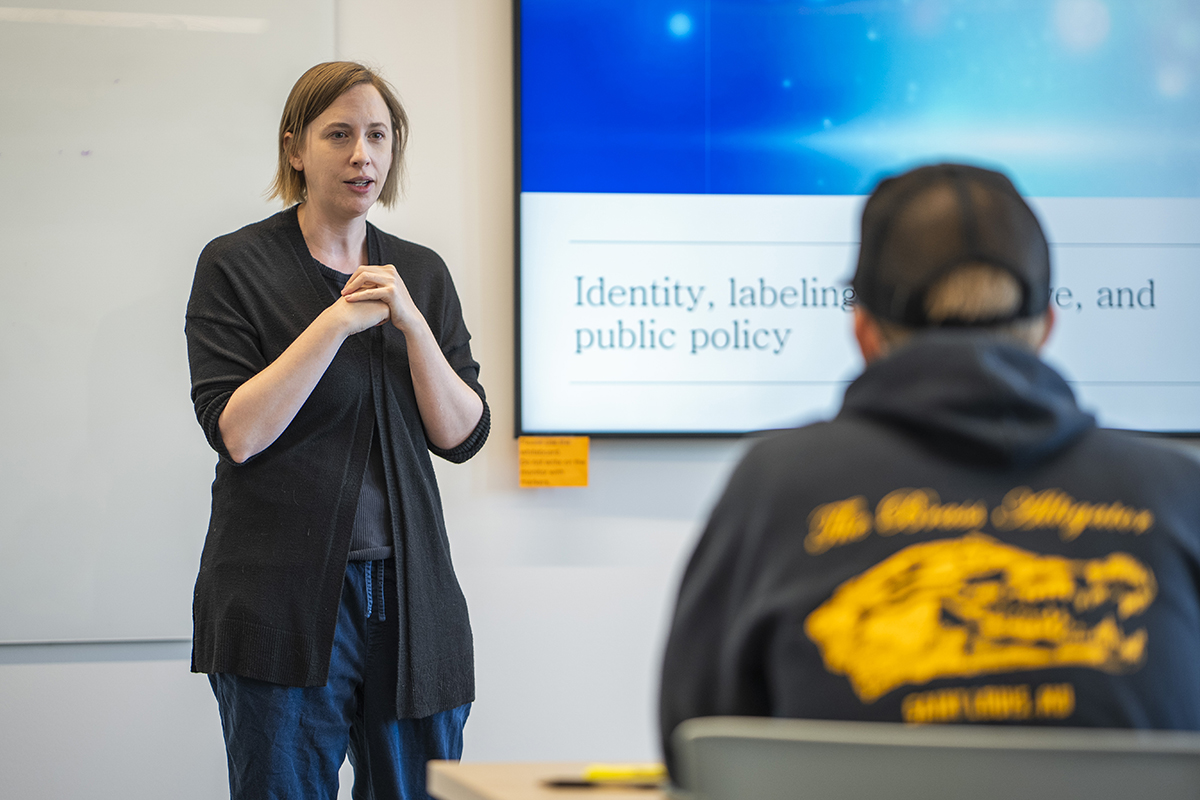
Meaningful learning depends on connection, Perry says.
An opportunity instead of an obligation
Not all students love writing, nor are they required to. For some students, written assignments may feel like an obligation or an outright burden. In such situations, the allure of LLMs hardly needs explaining.
Even so, I would caution students to pause and reflect on the costs of using LLMs to do their work for them. Even for students who dislike writing, these assignments exist as an opportunity to share, connect, and teach. Every student has a story worth telling.
As one of my colleagues put it, “college is the last time anyone will be required to read your writing.”
So what do you have to say?
Sources and Resources
- Pew Research Center: About a Quarter of U.S. Teens Have Used ChatGPT for Schoolwork
- ChatGPT for Students
- STLCC Academic Rights and Responsibilities
- STLCC Artificial Intelligence Syllabus Guidance
- STLCC Enrollment Reports
- Nature: AI Models Collapse When Trained on Recursively Generated Data
- The Scholarly Teacher: How AI Is Making Discussion Boards Obsolete
- K. Patricia Cross Academy: Combatting Isolation in Online Courses
- UNC Writing Center: Generative AI in Academic Writing
- STLCC Academic Success and Tutoring
- STLCC Writing Resources
Amy Perry, PhD, is an associate professor of sociology at St. Louis Community College.
The views expressed are those of the author and do not necessarily reflect those of St. Louis Community College.
Using AI responsibly in the classroom and beyond
Explore resources for students and faculty to support learning, strengthen teaching
and build real skills.