A Recipe for Success: STLCC’s Updated Culinary Spaces
November 13, 2026
Posted by STLCC-Forest Park in Programs and Pathways
An old kitchen saying goes that a great chef never blames their tools. But anyone who has worked with an unreliable stove or struggled to find counter space during a busy dinner service knows that the right equipment can make a big difference.
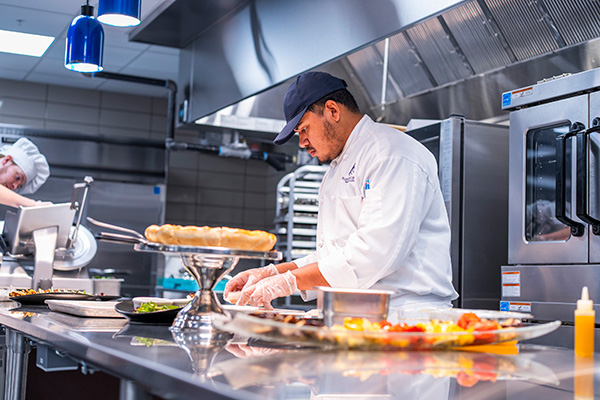
At St. Louis Community College, culinary arts and baking and pastry arts students are learning in updated kitchens designed to help them build skills and prepare for their careers.
As part of the districtwide STLCC Transformed initiative, the hospitality and culinary facilities at STLCC-Forest Park underwent major renovations. The updated spaces give students access to modern equipment, more room to work and kitchens that reflect what they can expect in the food industry.
Modern Kitchens Built for Students
STLCC is home to the oldest culinary school in St. Louis. But the previous facilities, largely unchanged since 1999, were showing their age. Some stove burners no longer worked, pastry students had to walk down the hall for ice and students often competed for counter space and oven time.
Faculty helped plan the updated kitchens, with a focus on creating spaces that are easier to use and better reflect professional kitchens.
“They’re able to learn in a clean, modern environment that closely reflects the workplace,” said Ellen Piazza, culinary arts program coordinator. “The equipment shapes how we teach, and our new setup gives students experience with the kind of production line they’ll find in a restaurant or commercial kitchen.”
In the advanced culinary lab, each student station now has its own oven, flat top, stovetop, prep surface and sink. The kitchen also includes commercial-grade specialty equipment that allows students to practice a variety of cooking techniques.
“Just for each team of students to have their own complete setup to work with... class runs much more smoothly and they get much more out of it because they’re not jockeying for equipment or crowded in some place,” said Mike Dewes, assistant professor of culinary arts. “It gives them a much more realistic version of an education based on what they’ll see when they leave here.”
A Better Space for Baking and Pastry Arts
The baking and pastry arts lab received major updates, too. Baking often requires precise temperatures and careful timing, so having the right equipment and enough workspace is especially important.
The renovated lab now includes under-counter refrigeration at every station, a larger shared dish room, a dedicated ice machine and overhead demonstration cameras. The cameras allow instructors to show techniques on screens at each table, making it easier for students to follow along.
“Baking is so sensitive to the environment,” explained Abby Benz, baking and pastry arts program coordinator and an STLCC alum. “We’re in the chocolates class right now, so I’m able to have all my chocolate equipment here and (have our students) experience chocolate in the proper way... Now we’re able to run smoothly, gain back time in the little spots to where we’re able to get through everything and do it successfully.”
Students who experienced both the old and updated kitchens can see the difference.
Dual culinary and pastry student Evelyn Thoele said having everything students need at their workstations makes classes run more smoothly.
“The advanced lab rooms are so good,” Thoele said. “Everyone has everything they need at their station instead of everyone having to move around... Everyone has a sink, a station, a flat top and a stovetop, and that was not at all what it was like before.”
Building Skills and Confidence

Culinary arts students at STLCC-Forest Park showcase their dishes and receive feedback in the college’s updated culinary facilities.
Learning on equipment commonly used in professional kitchens helps students become more comfortable with the tools and techniques they may use in their careers. It also gives them more opportunities to practice working independently and as part of a team.
For Evelyn Bartlow, culinary student and president of the student Culinary Club, getting to use the new equipment has been especially meaningful.
“I work in an Asian restaurant and we have woks, and I know how to use woks. And there’s a brand-new wok [here] and it doesn’t even have its patina yet, which is the black coating,” Bartlow shared. “It’s just really exciting to get your hands on something that’s super new and getting to break it in yourself, because it feels like you’re putting a piece of yourself into it. And every student after that is going to imbue kind of like their spirit into it... it kind of feels like an honor.”
The renovations have also changed how students spend time together outside the kitchen.
Updated common areas give students places to study, talk with classmates and build connections. Dewes said he has noticed students spending more time in the department, even after classes end.
“Something I’ve noticed, especially as newer faculty, is just that students want to spend more time in our spaces,” Dewes observed. “Not just in the kitchens, but in the common spaces, like the back hallway of our department, with those new booths looking out on the new courtyard. It’s nice to have students want to be in our facility... to just get to know each other and feel comfortable outside of the instructional environment. I see groups of students studying together in these spaces when without those spaces they might not have been inclined to do that.”
Culinary Club Vice President Kirby Webb said those connections are an important part of the college experience.
“All the things we’ve talked about that we’re experiencing — feeling that camaraderie with other chefs and learning from other chefs and making friends—those are just things that you’re not going to necessarily get when you’re a line cook,” Webb said. “It is well worth your time in order to enrich your culinary education.”
Investing in Students' Futures
For faculty, the renovations represent more than new equipment and updated classrooms. They show students that STLCC is committed to helping them succeed.
“When students see the renovations, they see an investment in them and their futures,” Piazza reflected. “The students see that the College cares about their dreams and is committed to giving them the best possible chance to become who they want to be. I think that is incredibly powerful.”
With updated kitchens, improved classroom spaces and more opportunities for students to connect, STLCC's culinary arts and baking and pastry arts programs are helping prepare the next generation of food industry professionals.
For Bartlow, that preparation is about more than learning how to cook.
“Food is the great equalizer. And it's not just food,” Bartlow said. “It extends beyond the plate. It's the world beyond. It is something that everybody can benefit from.”
Turn Your Passion for Food Into a Career
Get started in culinary arts or baking and pastry arts at St. Louis Community College. Learn from experienced instructors, build your skills in updated kitchens and prepare for opportunities in the food industry.
Learn more about STLCC's culinary arts program and baking and pastry arts program.