From Classroom to Code: How an STLCC Nursing Graduate and Her Dean Teamed Up to Save a Life
September 23, 2026
Posted by STLCC in Programs and Pathways
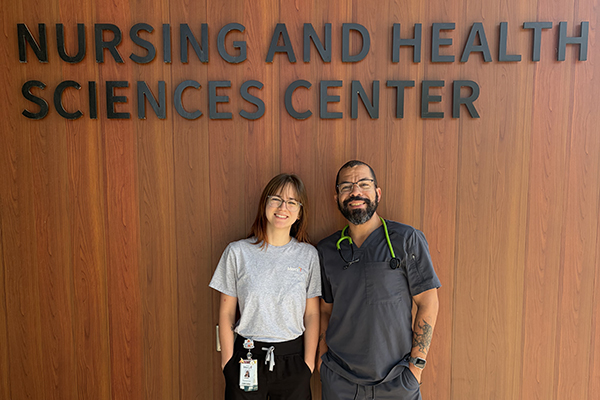
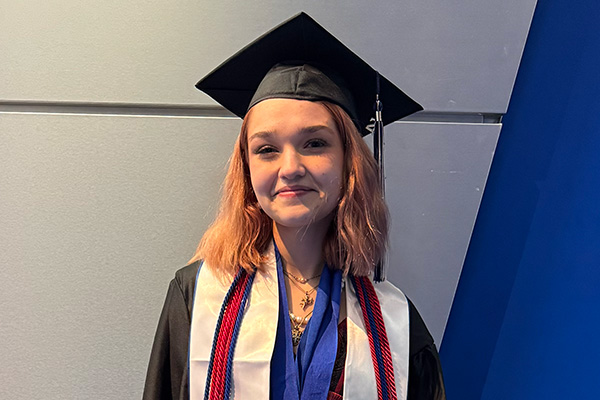
The shift started out quietly in the acute care section of the emergency department at Mercy Hospital South. Amelia Weber, who graduated from St. Louis Community College’s nursing program in December 2025, was getting to know her patient. His case seemed to be pretty routine.
“The day was beautiful. It was great,” Amelia recalls. “We were in the room laughing. So it was really nice. It was fantastic.”
Then everything changed.
For Amelia, what happened next was the kind of moment every nurse trains for but hopes never comes. It was also a moment that showed the value of an STLCC nursing education. The training she received prepared her not just to pass exams, but to think critically, respond quickly and step confidently into patient care from the moment she walked into the ER.
As Amelia puts it, STLCC’s nursing program was never just about what was going to be on the test.
“Honestly, I think because it's not only the importance of ‘we're here to teach you so you can pass the NCLEX (National Council Licensure Examination),’ but it also goes a little bit further with ‘we're teaching you so you can go out there and actually be a nurse day one’,” she says.
That difference matters. For Amelia, it mattered almost immediately.
Amelia had started the patient’s IV and stepped over to her desk just outside the room to chart. Moments later, she heard him cough. In a busy emergency room, a cough isn't always alarming — until it is.
“Looking back in hindsight, there's something called the cardiac cough. It's a very specific cough that people do and it's how we know that they're having something wrong with their heart,” Amelia says. “I heard that and I immediately jumped up and ran into the room, and he's clutching his chest and he looks at me and says, ‘Amelia, something's wrong.’ He said my full name, and my stomach dropped.”
But even though she felt the stress in her gut, she didn’t freeze; she jumped into action.
“At that point, all of your schooling and your training really comes in because it's like you walk into the room, your patient's short of breath. I had just started a medication on him. So the first thing I think is, ‘Oh, medication.’ So I stop the medication,” she explains. “While I'm rallying the troops and having them come in, he just kind of falls back. At that point, I notice we're not breathing. So I check his pulse. Felt none so I immediately jump on, start doing chest compressions, and then that's when we call everybody. Everybody.”
A Synchronized Response and a Guiding Hand
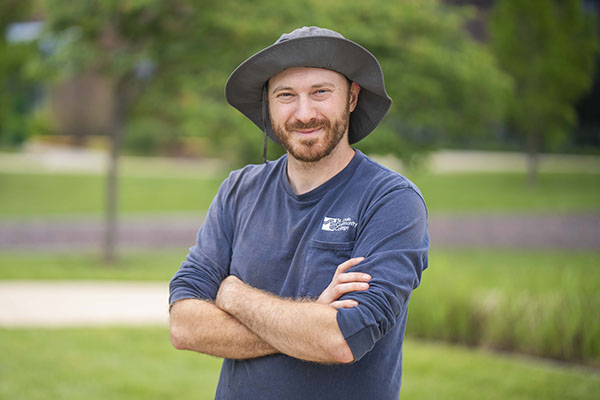
Running into the room alongside her was the emergency nurse practitioner on duty: Jordan Cooper, DNP, APRN, FNP-C. But Jordan wasn't just another provider in the department — he is also the division dean of nursing at STLCC.
Together with attending physicians and emergency staff, Amelia and Jordan worked together to resuscitate the patient.
“So we're doing compressions, I've got the bag, trying to get him ventilated. We open up our cart to try to get it hooked up to the monitor, get ready to shock him, do whatever we’ve got to do,” says Jordan. “We brought over one of our attending physicians, and then when he ran over, then it became like eight, nine more people. We just went to work using our training for about an hour and a half or so.”
Thanks to the team's swift intervention, the patient was stabilized and transferred to the intensive care unit.
“When you have a good team there, codes run just beautifully,” Amelia reflects. “It's perfectly timed, your meds are given, it's really quite an amazing thing to watch the team go together, everybody has their specific roles, and we're just kind of working almost like an assembly line on this patient to get him back.”
Connected in the Classroom and at the Bedside
For Jordan, watching Amelia take command of a code blue was a full-circle moment. Jordan himself graduated from STLCC-Florissant Valley in 2015 before advancing in clinical practice, earning his doctorate and stepping into academic leadership. Yet even as dean, he continues to see value in working weekend shifts in the ER to keep his practice current.
“Our faculty, a lot of them are still in practice, whether that's maybe during the summer or during breaks or maybe occasionally on the weekends. We see our students a lot, especially in the field,” Jordan says. “I think it's good to know that not only are we passionate about making sure that we're educating and supporting the next generation of nurses, but we still keep our practice relevant by staying at the bedside when we can.”
That continued connection to patient care matters in how Jordan works with faculty to shape the nursing program at STLCC. It also shapes the way he approaches his work with other nurses in the hospital.
“It's meant to be collaborative. It's not meant to be dictating to,” Jordan says. “So a large portion of my role in that advanced position is to help mentor and train and explain why we're doing things and understand what the plan of care is so that the left hand knows what the right hand is doing.”
Amelia noticed that approach early on.
“I always found him to be very approachable, which is really important,” she says. “As a new nurse, you'll see these orders come in, but you don't necessarily know why. So it's really nice to be able to go up to and be like, ‘Hey, so I'm new, but I noticed that you ordered this. What are you thinking? Why is the plan of care shifted? Why are we now doing this?’”
When Jordan saw Amelia jump into action during the code, he knew exactly where that foundation came from.
“When she did what she did, I knew what course she learned that in, what instructor told it to her, and when they did. I actually went back and I told her and her team and her former program coordinator from the campus. She goes, ‘I told her that.’ I'm like, ‘I know you did’ I was incredibly proud.”
Learning How to “Think Like a Nurse”

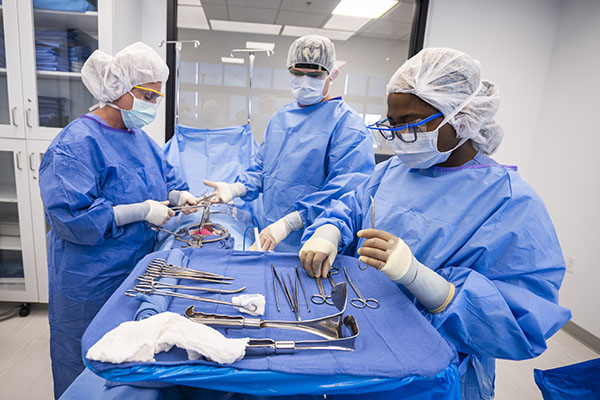
An STLCC nursing instructor works with a student to practice patient care techniques.
Both Amelia and Jordan agree that preparing nurses for high-pressure medical situations isn't about memorizing definitions. It is about developing clinical judgment through hands-on practice, repetition and support.
“Studying for nursing school is not like studying for your prerequisites. It's completely different because it's all on critical thinking,” Amelia explains. “It's like, now you have a patient with this, what do you do? What do you anticipate being ordered? You can't really just read a book on that. You have to take these practice questions, you have to talk to your advisors and get with the tutors and really go over this stuff.”
Amelia, who spent her time at STLCC serving as president of the Student Nurses Association and working as a peer tutor, found that the College's advanced simulation labs transformed lessons into real instincts.
“I watched my classmates get comfortable talking to patients using those robots and being able to come in because at first, you do feel awkward going in. But if you could take the clips from our first [simulation] lab at first semester and our last sim lab at fourth semester, you know, we're practicing skills, [it looks] completely different.”
For Jordan, that level of competence proves the core strength of STLCC’s nursing curriculum across its campuses.
“It's understanding that that it's not about a particular area. It's not about whether or not we taught you more in pediatrics versus emergency medicine. It is: Did we teach you to think better as a nurse? Did we teach you to critically think your way out of a situation? Seeing that, I'm very proud, I'm very happy to see it.”
Faculty Who Walk Alongside You
Beyond classroom technology, Amelia credits the accessibility of the instructors at STLCC for getting her through tough academic hurdles — such as mastering medication calculations.

STLCC nursing students train in simulation labs designed to reflect clinical care settings.
“I remember sitting in class and I got so frustrated. I did start to have tears come down my face because I was struggling with it so bad,” Amelia recalls. “And that teacher pulled me aside and she goes, ‘Okay, you liked chemistry. You can do it this way here.’ And she taught me how to do it in a way that I understood. When I took my ATI med calculation exam, I got 100%. So shout out to my teachers because they definitely helped me.”
That culture of mentorship continued after the emergency event at Mercy South. After the patient was taken upstairs to the ICU, Jordan took Amelia for a walk to process what had happened.
“After that all happened, and we got the patient upstairs he says, ‘Okay, let's take a walk and just get out the ER for a minute.’ Yeah, get some air. And then we just sat and talked,” Amelia remembers. “It was just getting that reassurance, especially from the provider side.”
Advice for Future STLCC Nursing Students
For anyone considering a healthcare career or preparing to start their first semester at STLCC, Amelia's advice is simple: lean into the support system around you.
“Use your office hours,” Amelia urges. “You don't have to have a specific question when you're going in there. You can just go in there and be like, ‘Hey, I feel bad about the endocrine system, help me.’ And they can, and they will. Please use the teacher's time because they want to teach you.”
Jordan sees Amelia’s success as a testament to the College's mission and academic standards.
“My whole purpose, my whole reason for wanting to become the dean of Nursing is to make the program better and to make sure our students are better protected and to provide an avenue for students to become nurses who may not have,” Jordan says. “The best thing we can do is make sure that when they come from STLCC, (healthcare providers) know that you're going get a really strong, competent nurse, a safe nurse, and someone you can trust your life with.”
For Amelia, the lesson from that shift is one she shares with anyone interested in nursing: you never know when a routine moment will become something far from routine, when all of your training will need to kick in.
At STLCC, that reality is part of the preparation. In classrooms, simulation labs, clinical settings and faculty offices, students learn not only the technical skills of nursing, but the art of patient care in all settings.
Start Your Nursing Career at STLCC
Prepare for a career in nursing with classroom instruction, simulation labs and clinical experience. Learn more about STLCC’s associate in applied science in nursing program, admission requirements and steps to get started.