Opening Act: How STLCC Graphic Communications Students Help Promote the Arts
September 14, 2026
Posted by STLCC in Programs and Pathways
Like a great art exhibit or play, the poster promoting it is a work of art. It is, in a sense, the opening act. The image on a placard or postcard grabs the viewer’s attention long before they take their seats or enter the gallery.
At St. Louis Community College, graphic communications students help create that first impression through a cross-departmental collaboration that turns classroom assignments into the public face of the College’s arts programming.

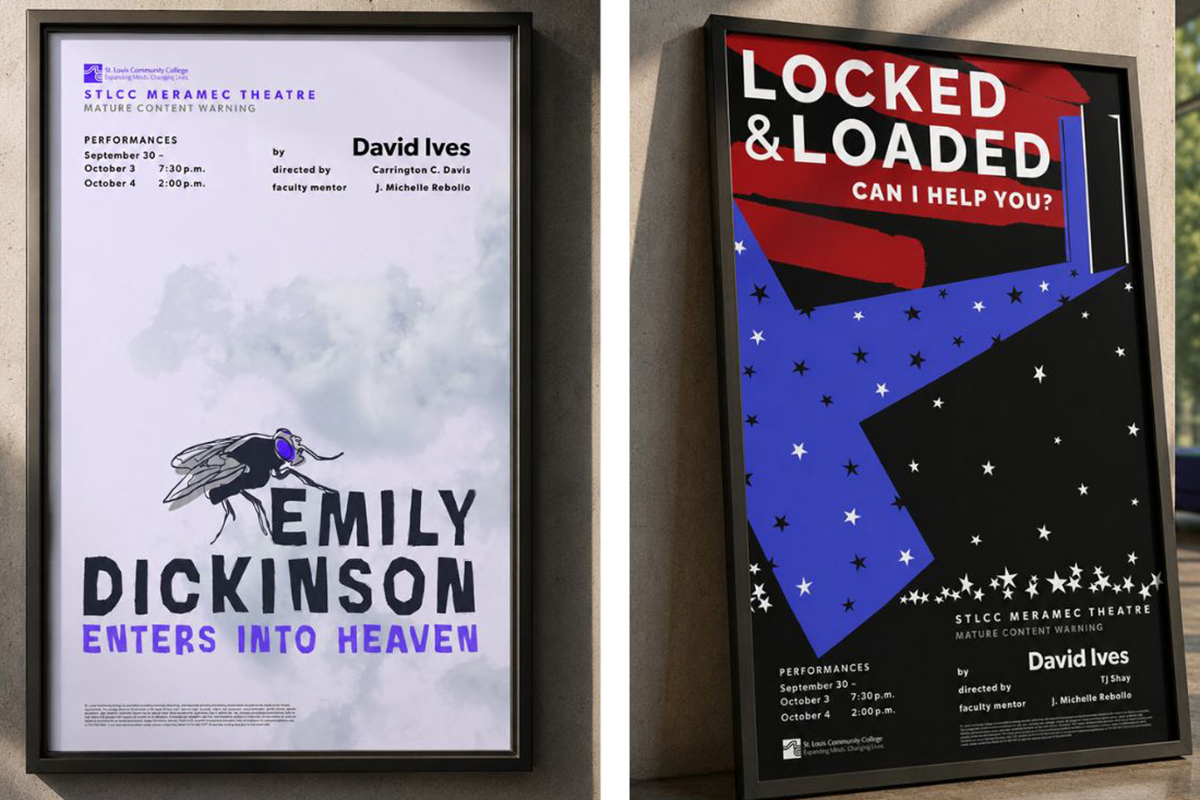
STLCC graphic communications students create posters for theatre productions across the College.
“More than 10 years ago, we at Meramec initiated this tradition that brings design students and the theatre program together to create work for real productions, and it has grown into a meaningful and lasting collaboration,” says Michael Swoboda, graphic communications program coordinator at STLCC-Meramec.
“Partnering with the theatre program gives our design students something a classroom alone can’t: a real client, a real audience, and a real deadline,” Swoboda says. “Each production brings a new story, a new visual language, and a new deadline. And, each time, our students answer the call, translating a script into posters, programs and promotional materials that capture the spirit of the show.”
Michelle Rebollo, theatre and communications professor at Meramec, says she’s been impressed by the talents and professionalism of the design students she’s worked with over the years.
“The students’ commitment to collaboration really makes this a wonderful partnership,” she says. “They come prepared to do the work. They’ve read the play and done the research, and they remain open to dialogue throughout a very iterative process.”
Swoboda’s summer session Graphic Design III students recently took on the challenge of designing two different posters for the upcoming Student-Directed One-Act Play Festival: Celebrating the Unpublished Works of David Ives, opening September 30 at Meramec Theatre.
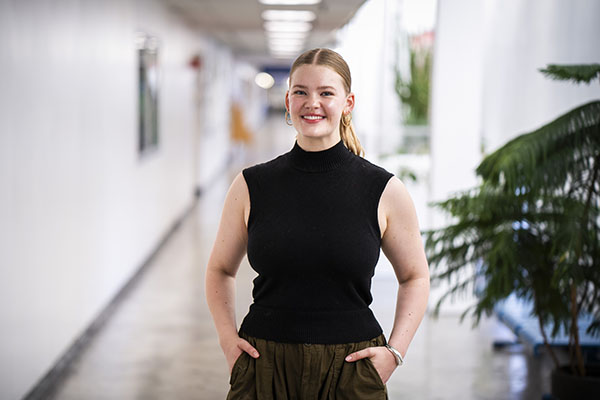
“Working with the faculty director, student director and my classmates brought together different perspectives to create designs that supported and reflected the vision of the productions,” says Becca Bellevile, whose posters for “Emily Dickinson” and “Locked and Loaded” were selected for use.
“Throughout the process, we participated in several critiques with the student directors, and their feedback played an important role in shaping the final designs. Those conversations challenged me to think more deeply about how visual design can communicate mood, story and the unique identity of a theatrical production.”
Florissant Valley Graphic Design Student Builds Portfolio and Confidence

Micah Smith designed the poster for STLCC-Florissant Valley’s production of “Almost, Maine.”
Susan Stuart, graphic communications program coordinator at STLCC-Florissant Valley, describes the collaboration as a “win-win” for students and the theatre department.
“We love the partnership, and so do all of our directors,” says Marie McCool, manager of STLCC-Florissant Valley’s Terry M. Fischer Theatre. “Typically, we go meet with the class, explain the ideas we have with the theme of the show, and let them do their thing. Usually, we get five or more designs to choose from, and the directors and cast decide which is their favorite.”
According to Stuart, for students in her Graphic Design III and IV classes at Florissant Valley, the assignment signals a shift to “real-world” work.
“What they’ve been doing in school is taking their own ideology and concepts to a project,” Stuart says. “But this time, it’s about the client’s expectations.”
Micah Smith, whose poster design was chosen for the Florissant Valley production of “Almost, Maine” last spring, says this assignment marked a turning point for him.
“It really helped me learn about how client-based assignments work and how deadlines are really important, especially when it’s a show or a certain event that is happening on a set date,” he says.
Smith not only got to see his work used to advertise the play, but the design also won him the Faculty Choice award for graphic communications in the 2026 Florissant Valley student art exhibition. And that’s not all: This summer, Smith landed an internship at the Eaton Experience Center in Ellisville.
“I think this project really did help me in securing that internship not just because of the work that I displayed in my portfolio, but also for what it gave me in return,” says Smith. “It gave me a lot of confidence that I can work in a professional environment with fast deadlines. In the end, I am so grateful to have gotten this project and the chance to have it in the theatre. It just opened so many doors for me.”
Stuart’s fall semester design students have already begun meeting with the Florissant Valley theatre department to start work on the poster for The Butler Did It, which opens November 12 at the Terry M. Fischer Theatre.
Beyond the Stage: Designing for the Gallery

Isabella Laidley created the poster for David Hanlon's “Borrowed Time” exhibit.
“Real client work gives a student designer a first taste of what design really is: collaboration, constraint and often negotiation,” says Irina Pavlova, assistant professor of graphic communications at STLCC-Meramec. “And when it all comes together, there is a particular rush of seeing something you made out in the wild, being experienced by other people.”
For Isabella Laidley, a student in Pavlova's summer Portfolio Design and Workplace Preparation class, designing the poster for David Hanlon’s Borrowed Time exhibit, on view in the Meramec Contemporary Art Gallery through Sept. 22, provided a unique opportunity to translate an artist's work and character into a visual identity for the gallery show.
"This is the first poster I designed that got chosen and is being put up in a public space," Laidley says. "So, it is really cool to see the work I've done hung up, and other people appreciating it."
To capture the essence of Hanlon's photography, Laidley researched his website and considered her instructor's descriptions of his style.
“Professor Pavlova made some good points about how elegant his work is, how simple it is, and how, as a person, he's very soft-spoken. Those are elements I wanted to incorporate into my poster, highlighting his photograph as the main feature and not wanting to take anything away from that.”
“This project added another layer because Isabella was designing for another creative,” says Pavlova. “The challenge was to find a way for her own visual voice to exist in conversation with the photographer. Isabella did a terrific job of understanding the visual and conceptual language of the work and created an identity that honored it without simply imitating it. That is one of the true challenges and joys of being a working designer.”
A Foundation for Professional Design Careers
The cross-departmental partnerships at Meramec and Florissant Valley offer design students a great opportunity to try that role, but it is far from the only one.
“This kind of experiential learning is central to how we teach,” says Swoboda.
“Some of the most valuable moments in a design student’s education happen when the work leaves the classroom,” says Swoboda. “When a student sees their poster on a theatre wall, in hallways, and on screens and realizes that hundreds of people are going to encounter something they designed, the assignment suddenly becomes very real. They begin to understand that graphic design isn’t just about making something that looks good. It’s about understanding a message, solving a communication problem and taking responsibility for how that message reaches an audience.”
Graphic communications students at STLCC design for real clients throughout the program, and a design internship is a graduation requirement for the NASAD-accredited two-year degree — ensuring students leave ready to excel in professional design careers.
Want to see more of what’s happening in the arts at STLCC? Subscribe to STLCC Arts Connection, our monthly e-newsletter featuring visual and performing arts events, exhibits, productions and student work across the College.