What Surgical Technologists Do and Why Their Work Matters
June 02, 2026
Posted by School of Health Professions in Programs and Pathways
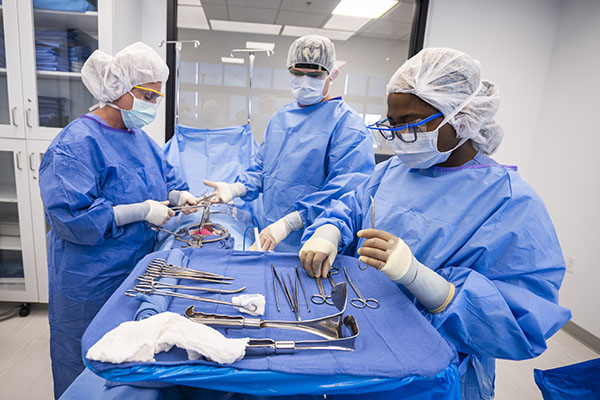
A surgical technologist, often called a “surgical tech” or “scrub tech,” is an allied health professional who plays a critical role in every surgical procedure. They are part of the sterile surgical team that works alongside surgeons, nurses, anesthesiologists and other specialists to ensure that operations are safe, efficient and free from infection.
For students interested in a health care career, surgical technology offers a direct way to work in the operating room and support patient care. It is a fast-paced, team-focused role where attention to detail can make a major difference.
“A career as a surgical technologist places you at the heart of the operating room, where you help prepare for surgery, maintain sterility, support the surgical team and play a key role in patient safety,” said Emily Albers, surgical technology program director with St. Louis Community College.
Because of the precision, teamwork and critical thinking required, surgical technologists must not only master technical skills but also learn how to communicate clearly under stress and work collaboratively with highly trained professionals.
What Does a Surgical Technologist Do?
Surgical technologists help prepare the operating room before patients arrive, assist during surgery and help with cleanup and turnover once surgery is complete. Their work helps the surgical team stay organized, sterile and focused on patient safety.
Here are key responsibilities of a surgical technologist:
- Prepare the operating room (OR) by gathering equipment, organizing surgical instruments and setting up the sterile field before patients arrive.
- Assist during surgery by passing instruments to the surgeon, anticipating needs, handling sutures, sponges and implants, and maintaining strict aseptic technique throughout the procedure.
- Support patient safety by counting instruments and sponges to ensure nothing is left inside a patient, and by maintaining proper infection-control practices.
- Help with cleanup and turnover of the operating room once surgery is complete.
In short, surgical technologists are an integral part of the operating room. Without them, surgical procedures would not be as efficient or safe, and patients would face higher risks during surgery.
Demand for Surgical Technologists
Growing Job Opportunities
According to the U.S. Bureau of Labor Statistics, the employment of surgical technologists is projected to grow faster than average for all occupations over the next decade.
Here’s what that means for students considering a surgical technology career:
- Positive job outlook: An estimated 5% growth in jobs from 2024 to 2034 suggests that surgical technology will continue to be in demand, driven by an aging population, technological advances and increasing outpatient surgical procedures.
- Consistent openings: Around 8,700 new positions are expected annually on average, many due to retirements or shifts in health care roles.
In the St. Louis area specifically, the surgical technology field is actively hiring surgical techs. Local hospitals, surgery centers and health care facilities need trained professionals who are ready to work in operating room settings.
Earning Potential After Graduation
The compensation for surgical technologists varies by experience, location and facility type, but in St. Louis the outlook is strong. Recent salary data shows that:
- The average salary for a surgical technologist in St. Louis is about $69,976 per year according to recent job survey data.
- Entry-level surgical technologists typically start lower but can grow quickly with experience and certification.
- Compared to other careers requiring similar amounts of education, typically one to two years, surgical technology provides a strong return on investment, especially when education costs are minimized.
Why St. Louis Community College Is a Smart Pathway

STLCC’s surgical tech program prepares students to support surgeons, nurses and patients as part of the sterile surgical team.
For individuals in the St. Louis metro area who want to become surgical technologists, attending St. Louis Community College is compelling for several clear reasons. STLCC offers affordable education, local training, hands-on experience and certification preparation that can help students move from the classroom to the operating room.
1. Affordable Education
Education cost is one of the biggest factors for prospective students, and community colleges offer some of the most affordable programs available.
- At STLCC, completing the associate in applied science (AAS) surgical technology degree typically costs approximately $8,300 for in-district students, including tuition and required fees.
- Even out-of-district or out-of-state students pay only modestly more compared to private schools or technical institutes.
“The idea of going to a school that cost significantly less than a four-year university was very important to me,” said 2025 graduate Sarah Arnold, who works at Mercy Hospital St. Louis, assisting in several types of surgery. “I am grateful to say that I was raised by parents who really helped me understand the weight of debt, and who tried to steer me away from it.
“Seeing that STLCC had a surgical technology program was huge to me for so many reasons, but the affordability of it was significant in my choice. I am grateful to be completely debt free from all of my schooling.”
Nationally, surgical tech programs can range from $10,000 to more than $30,000 when completed at private institutions or specialty schools, and many students take on significant debt.
In contrast, STLCC’s program is priced well below average and provides a high-value education with minimal financial strain.
2. Accessibility and Local Training
Unlike many programs that require relocation, STLCC’s surgical technology program is fully offered on campus at the Forest Park campus, right in the heart of the St. Louis metro area.
This means:
- Students can continue to live at home or nearby while training, saving on housing and living expenses.
- The program partners with local area hospitals to provide students with clinical experience without long commutes.
- Students are trained where they may work, and many local employers recruit directly from STLCC clinical sites, increasing the likelihood of employment after graduation.
“The surgical technology program at STLCC has a long-standing reputation in the community with local area hospitals,” Albers said. “When students attend clinicals, they are working one-on-one with the hospital employees, gaining all of the knowledge they need to be successful after graduation.”
National research shows that community college programs often serve local job markets better because they tailor training to local employer needs and maintain more accessible enrollment requirements.
3. Hands-On Training and Certification Preparation
Because surgical technology is a highly hands-on profession, the quality and structure of training matter. STLCC integrates:
- Classroom instruction for foundational knowledge on subjects such as anatomy, aseptic technique and surgical procedures.
- Laboratory skill practice using real equipment.
- Clinical rotations in actual operating rooms with surgeons and OR teams.
- Preparation for the National Board of Surgical Technology and Surgical Assisting (NBSTSA) certification exam.
This blend of classroom and experiential learning ensures that graduates are not only competent but also job-ready from day one.
“We’re fortunate to have a lot of the same technology in our lab that closely reflects what students will see in local area hospitals,” Albers said. “With four separate operating room practice spaces, we’re able to provide meaningful, hands-on practice in a realistic setting.”
4. High Pass Rates and Job Placement
Performance indicators for STLCC’s program are strong, with data showing that a significant majority of graduates:
- Successfully pass the national certification exam, a key credential employers look for.
- Secure employment as surgical technologists or in related fields shortly after graduation.
These outcomes speak to the quality of the instruction, the relevance of training and the strength of the College’s network with local health care employers.
5. Support Services for Students
STLCC is not just about classes. The College offers a suite of student support services to help students succeed, including academic advising, financial aid guidance, stress management resources and more.
Such support can make a major difference for students juggling school, work and personal responsibilities.
Compare Community College vs. Other Training Routes
When choosing how to enter the surgical technology field, there are several distinct educational pathways, and community college stacks up exceptionally well.
Community college programs such as STLCC offer:
- Lowest cost for accredited training.
- Hands-on clinical experience.
- Local employer connections.
- Clear pathway to certification and employment.
- Less debt and financial risk.
Industry experts consistently emphasize that accreditation, hands-on clinical skills and employer reputation of the program matter more than how fast you finish, and the STLCC program hits all of those marks without the high cost.
A Smart, Affordable and Career-Ready Path

Surgical technology students learn the purpose and proper handling of common operating room instruments.
Choosing to become a surgical technologist through St. Louis Community College combines affordable education, rigorous hands-on training and strong career prospects, making it a smart pathway for students in the St. Louis metro area.
By keeping costs manageable, aligning training with local job demand, providing access to clinical experience and preparing students thoroughly for certification and employment, STLCC maximizes the return on time and financial investment. In a growing health care field with stable demand and solid salary potential, this pathway positions new graduates for success without unnecessary debt or geographic upheaval.
“I benefited greatly from attending STLCC,” Arnold said. “I have been told by countless peers and mentors that STLCC's program is the ‘cream of the crop’ for programs in the area. I have met several alumni from this program who have expressed their gratitude for attending this program and how it positively affected their experience in the field.
“My greatest benefit from this program is that the instructors offer such immense support, knowledge and a desire for student success. I felt very prepared as I stepped from our hands-on lab class into clinicals, and additionally as I stepped into my career upon graduation, due to this program. I am grateful every day for this program and how it changed my life.”
If your goal is to enter a meaningful, high-impact role in health care where your work literally supports life-saving procedures, then earning your surgical technology degree through STLCC is one of the smartest ways to get there.
Start Your Surgical Technology Career at STLCC
Prepare for a career supporting surgeons and other members of the operating room team. Learn more about STLCC’s surgical technology program, admission requirements and steps to get started.