From One Lemon to a Career in Horticulture
May 12, 2025
Posted by School of Science, Technology, Engineering and Math in Programs and Pathways
Sometimes life gives you lemons. Or, maybe just one, single lemon.
“When I was 23, I was given a lemon tree at my first house,” Sarah Moore said. “It only produced one lemon, but I was hooked. I had to figure out where I could make plants a part of my daily job – I didn’t even know what horticulture was.”
Then, she found the horticulture program at St. Louis Community College–Meramec.
“And that just kind of set me off into my career,” Moore said.
Since then, Moore has earned an associate of applied science in horticulture and now teaches horticulture courses at STLCC-Meramec. She also serves on the horticulture program advisory committee, which includes local experts from across the green industry.
Horticulture is the art and science of plants, but it is also much more than that. People who go into the field can work in landscaping, gardening, stormwater management, cannabis and hemp production, research, parks and recreation, turf management, nursery and greenhouse management and more.
For students who are considering an education or career in horticulture or the green industry, STLCC is a strong place to start. Along with an associate of applied science degree in horticulture, the College offers certificates of proficiency in horticulture and cannabis and hemp production. STLCC also offers continuing education courses for students interested in nature, gardening, horticulture and ecology.
Start a Career in Horticulture at STLCC
Horticulture Goes Beyond the Garden
Horticulture is part of the larger specialty crop field, which includes fruits, vegetables, nursery crops and floriculture.
Source: U.S. Department of Agriculture
“I originally came to Meramec as part of a dual enrollment program with my high school and was immediately intrigued by the horticulture program,” said James Bruns, who is now an STLCC horticulture student.
Jerry Pence, horticulture program coordinator and assistant professor, said the program’s strong reputation is real.
“It’s not a myth, it’s reality,” Pence said. “We are the largest horticulture program in Missouri and have more students than most, if not all, four-year programs across the country. We have great connections with the green industry and bring local experts in to speak to students, teach as adjuncts, and give us tours for various field trips.”
Being the biggest does not automatically make a program the best, but STLCC’s size gives students access to resources they may not find at other schools. One highlight is the garden classroom on the Meramec campus, which covers more than 10 acres and includes scenic trails, perennial plants, pollinator areas and wildlife habitats.
“It’s huge for our students because having a working, outdoor garden classroom that’s treated as a lab, students are able to really do the things that they’re learning in lecture in real time,” Moore said.
“In this living laboratory, students engage in hands-on learning that bridges classroom theory with real-world practice,” said Assistant Professor Marcela Mora.
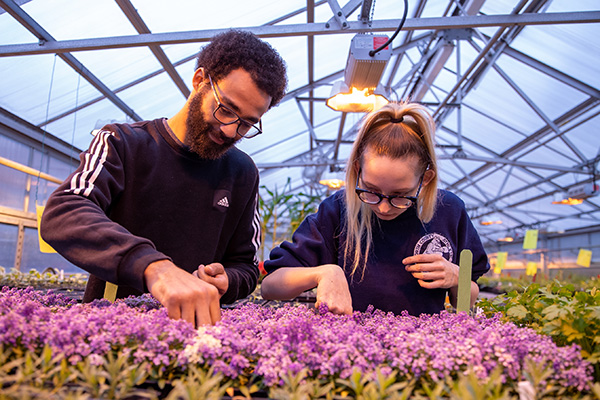
Bruns said he sees how professors use campus resources in class, including display beds for identification and landscaping courses and the greenhouse for labs and propagation.
Plant life is not the only thing growing in STLCC’s horticulture program. The program is also getting a new, state-of-the-art greenhouse, ready for use by fall 2025. The greenhouse supports the early stages of growing plants. The phrase “from seed to sale” fits the program well, since the campus typically hosts a public plant sale each spring with plants grown on site.
STLCC-Meramec is also home to more than 1,000 trees and has earned Tree Campus recognition from the Arbor Day Foundation.
Learn Horticulture Through Hands-On Training
“Sometimes when people think about going to a community college, they treat it as just the start of their education before they go somewhere else,” Moore said.
But Moore said the horticulture curriculum at STLCC is just as valuable as what students may find at a four-year university.
“I would challenge any bachelor’s degree program in horticulture up against our associate program because of the knowledge that is provided to the students,” Moore said. “It’s affordable for students and you’re not going to sacrifice the quality of learning that you get.”
The hands-on learning is what makes STLCC’s horticulture program stand out. Students do not only learn concepts in class. They can walk outside and apply those lessons in real time.
“We really pride ourselves on the hands-on learning portion of it,” Moore said. “Some of the other degrees that might be offered either in the state or in the surrounding states don’t compare.”
“Most of the classes I’ve taken have included a hands-on element and you couldn’t ask for a better campus for experiential learning,” Bruns said. “I’ve really appreciated being able to practice with equipment I wouldn’t have access to outside of this program.”
Moore said students can build practical skills whether they are pursuing a full degree or taking classes to learn more about a specific topic.
“We provide great hands-on applicable skills in our classes that you can get a foundational knowledge of plants, even if you just want to know a little bit more about, say, Missouri trees or wildflowers,” Moore said. “You can get just the basics if that’s what you’re looking for.”
STLCC horticulture students also take field trips to learn from industry experts across the St. Louis region and see how horticulture skills are used in real workplaces.
Connect With Green Industry Professionals
“We are consistently introducing our students to their future peers,” Pence said.
“It’s a thriving industry with abundant job opportunities and great potential for entrepreneurship,” Mora said. “Many graduates have gone on to establish successful businesses, and many professionals in the green industry actively seek our alumni.”
The horticulture community in St. Louis is closely connected. Many professionals, business owners and experts in the region also teach classes at STLCC, giving students direct access to people working in the field.
“I have been surprised by how tight knit the horticulture industry in St. Louis is,” Bruns said. “Being in the program has been a great opportunity to make connections with professionals in the field, many of whom are graduates of the program themselves.”
“We have experience in the industries you may want to work in,” said Assistant Professor Ryan Schepers. “We have an incredibly dedicated faculty that want to see you succeed.”
Moore, who was an STLCC horticulture student before becoming a professor, said one of the most meaningful parts of teaching is helping students make the same kind of connection she made.
When asked what advice he would give to prospective students, Bruns encouraged them to talk with faculty about their goals.
“I’d advise them to talk to any of the professors about their interests and goals related to horticulture,” Bruns said. “In my experience, all of the staff as well as my fellow students have been incredibly helpful while figuring out my own path.”
“Green is the future,” Pence said.
What Can You Do With a Horticulture Degree?
Green Careers Need Skilled Workers
The U.S. Bureau of Labor Statistics projects about 171,600 openings for grounds maintenance workers each year, on average, from 2024 to 2034.
Source: U.S. Bureau of Labor Statistics
The STLCC horticulture program is known throughout the St. Louis area and across Missouri. Because of its connections in the green industry, the program helps align students with the kinds of jobs and careers they want to pursue.
“Our curriculum will give you an edge over others,” Pence said. “We will prepare you for employment no matter which sector you choose.”
Pence said students who want to learn more should talk to current or former students about their experiences.
“Being a student worker, as well as taking classes like landscape maintenance, have been great opportunities for real-world experience with tools and techniques used in the horticulture field,” Bruns said.
Schepers said horticulture can lead students in many directions.
“I tell students that there are so many areas which horticulture degrees could be useful,” Schepers said. “You want to work in the park system? We can help. Want to work in research? Come take our greenhouse management class. Urban farming, conservation, biotechnology, landscape management, floriculture, so many other areas in which we can help you find a job.”
STLCC is also connecting horticulture to other STEM areas. Schepers said he will teach a biotech class that teaches students practical applications of plant biotechnology.
“Our hope is to give our students the skills to work at the several biotech companies here in St. Louis,” Schepers said.
“The green industry is a friendly industry, and you will be with like-minded people, outside, every day,” Pence said. “If it is your passion, you will do well in this field.”
Find a Flexible Path Into Horticulture
Lindsey Nissenbaum is a non-traditional student who takes horticulture classes when she can.
“I am here to learn more about native plants and the business of horticulture,” she said.
A few years ago, she and her husband started Gnomes for Natives, LLC. They design and install native gardens, primarily in residential areas.
“It’s an attainable and tangible way to improve our local ecosystem, and to spread enthusiasm for sustainability,” Nissenbaum said. “At this point, I am picking classes that seem most helpful to our mission, as I still have a ‘real’ job outside of our business.”
She expects to pursue a certificate as their business grows into a full-time occupation. Eventually, she hopes to add a native plant nursery and offer workshops on gardening and sustainability.
“Being a non-traditional student comes with an incredible amount of flexibility and autonomy,” she said. “You can choose the classes that interest and benefit you and build your schedule around your other obligations. The horticulture program has many classes designed for non-traditional students, with evening or once-weekly class sessions.”
Whether you are interested in one topic, looking for a second or third career path or already know the direction you want to take, STLCC’s horticulture program offers a wide range of options.
“It’s fun to be in horticulture,” Pence said. “We work hard, but we have fun doing it. If you don’t want to sit behind a desk in your future employment, horticulture offers you the opportunity to explore different avenues to be outside.”
“I’ve seen so many success stories, one being my own, where I was able to take my passion and turn it into a career,” Moore said. “And I owe it to the horticulture program.”
Who knew a single lemon could lead to so much?
Grow Your Future in Horticulture
Learn how STLCC’s horticulture program can help you build hands-on skills for careers in the green industry.