Health Care Careers Are in Demand. Here’s How STLCC Can Help You Start
May 08, 2025
Posted by School of Health Professions in Programs and Pathways
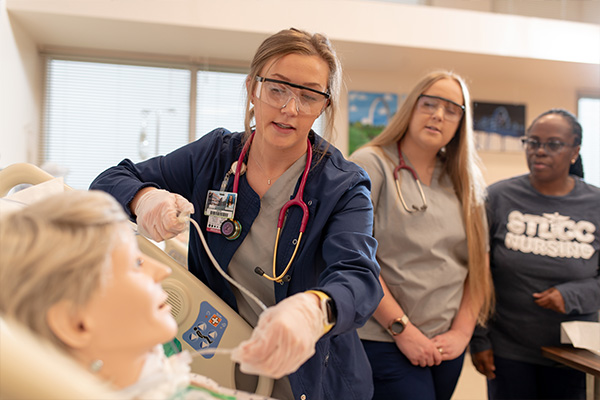
Health care careers are some of the most important jobs in any community. Hospitals, clinics and imaging centers need trained people who can care for patients, use advanced technology and support medical teams every day.
St. Louis Community College gives students a way to prepare for many of these careers through hands-on health care programs, clinical experience and affordable training close to home.
Each year, the Missouri Hospital Association studies the health care workforce across the state. Its 2024 Workforce Report (PDF) listed several hospital jobs with high vacancy rates, including nursing, surgical technology, medical imaging and diagnostic roles.
Many of those career paths connect directly to programs offered through STLCC’s School of Health Professions. If you’re interested in helping people, working with technology or preparing for a career with strong demand, health care could be a strong fit.
Health Care Careers Need Trained Workers
Health Care Is Growing
Federal labor data projects about 1.9 million openings in health care occupations each year, on average, from 2024 to 2034.
Source: U.S. Bureau of Labor Statistics
Health care is a large field, and not every role looks the same. Some professionals provide direct patient care. Others focus on imaging, surgery, lab work or specialized technology.
That range can be helpful for students. You may want a career where you work closely with patients every day. You may prefer a role that uses equipment, imaging systems or technical skills. You may also want a shorter training path that helps you enter the workforce sooner, then continue your education later.
STLCC offers several options that can help students build practical skills for these different health care settings.
Compare Health Care Program Options at STLCC
The table below gives a quick look at several STLCC pathways connected to high-demand hospital careers. Program length can vary based on prerequisites, course load and individual student plans, so students should review each program page and talk with an advisor before choosing a path.
Start With Nursing or Build Toward Advanced Care
Nursing is one of the most visible health care career paths. Nurses assess patients, provide care, give medication, support treatment plans and work closely with doctors and other medical professionals.
STLCC offers more than one way to start. The practical nursing program can help students prepare to become licensed practical nurses. It also gives students a pathway into the associate degree nursing program if they want to continue.
“Our practical nursing program at STLCC offers students an ideal gateway to a career because it allows students an entry point into the nursing profession for those who may not be ready for a full two-year program,” said April Norton-Gunther, assistant professor who oversees both the LPN and registered nurse bridge programs.
Students interested in becoming registered nurses can pursue STLCC’s associate degree in nursing. The program prepares students for licensure exams and bedside nursing care. It can also support students who later want to pursue a bachelor’s degree in nursing.
Prepare for Medical Imaging Careers
Imaging Careers Can Pay Well
The median annual wage was $88,180 for MRI technologists and $77,660 for radiologic technologists and technicians in May 2024.
Source: U.S. Bureau of Labor Statistics
Medical imaging careers can be a strong fit for students who like technology, anatomy and patient care. STLCC offers several programs in this area, including computed tomography, magnetic resonance imaging, radiologic technology and diagnostic medical sonography.
In computed tomography, students learn advanced imaging techniques that use X-rays to create detailed cross-sectional images of the body. This program is designed for radiographers, nuclear medicine technologists and radiation therapists who want to earn advanced credentials.
STLCC’s MRI program helps students learn to operate advanced imaging equipment while providing focused patient care. A significant part of the instruction takes place in MRI departments at health care partner facilities, so students gain experience in real clinical settings.
Students in radiologic technology prepare to work with X-ray and imaging equipment. They study anatomy, patient care, radiation protection and image evaluation while completing clinical experiences with hospital partners in the St. Louis region.
In diagnostic medical sonography, students use ultrasound equipment to create images that help providers evaluate patients. STLCC students choose one of three concentrations: general sonography, cardiac sonography or vascular technology.
“Being a sonographer means you are the eyes of the doctor,” said Lauren Pellegrini-Salsman, diagnostic medical sonography program chair. “Your job is to be an investigator and find out if a patient has normal anatomy or pathology. It is such a rewarding career with plenty of opportunity to grow in the field.”
Explore Focused Health Care and Transfer Paths
Some health care careers focus on a specific role within the care team. These paths can be a good fit for students who want hands-on work, a clear skill set and a direct connection to patient care.
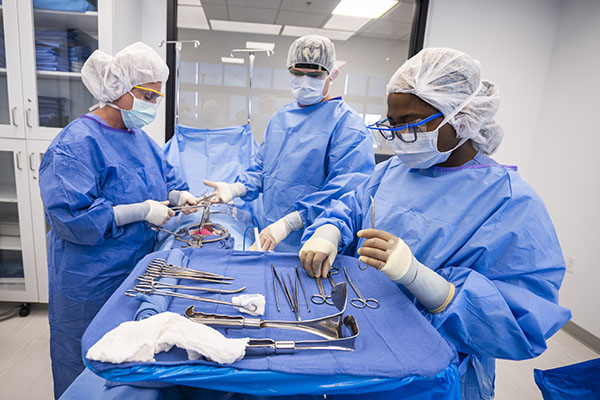
In surgical technology, students prepare to support surgeons and medical teams in the operating room. They learn sterile technique, surgical procedures, patient safety and how to assist during surgery.
Students interested in nuclear medicine can start at STLCC, complete general education requirements and transfer to a partner university. STLCC works with the University of Missouri and Saint Louis University, giving students a pathway toward a bachelor’s degree in nuclear medicine.
Why Students Choose STLCC for Health Care Training
STLCC’s health care programs are built to help students move from classroom learning into real patient care settings. Many programs include clinical experience with health care partners, which gives students a chance to practice skills in the types of settings where they may work after graduation.
Students also learn from faculty who have experience in the field. That matters because health care changes quickly. Students need instructors who understand current workplace needs, patient care standards and the professional habits employers value.
- Hands-on training: Many programs include labs, simulations and clinical experiences with health care partners.
- Experienced faculty: Students learn from instructors who understand health care workplaces and patient care.
- Affordable tuition: STLCC offers a cost-effective way to start a health care career or prepare for transfer.
- Career-focused programs: Students can choose from nursing, imaging, surgical technology, sonography and other pathways.
Start Your Health Care Career at STLCC
Health care can be a strong choice for students who want meaningful work, steady demand and a career that helps people. STLCC can help you compare programs, understand prerequisites and choose a path that fits your goals.
You don’t need to have every step figured out before you start. An advisor can help you review your options, look at program requirements and plan your next move.
Find Your Health Care Path
Compare STLCC health care programs and learn how to prepare for patient care, medical imaging, nursing and other in-demand careers.